Wednesday, March 5, 2014

Gem of the Week: Quartz

Quartz is a crystalline rock or mineral composed of silicon dioxide. Quartz attracts life force from your being and brings it into the physical world. This life force then flows through your body and helps to nourish your mind, emotions and physical body. Color: Multiple colors


Quartz is the second most plentiful mineral on the planet. The name is derived from the Slavic for hard. Quartz can come in many different colors and transparencies from completely clear to completely opaque. There are many different varieties of Quartz from milky quartz and smokey quartz to Amethyst and Onyx. Some varieties of Quartz are manufactured instead of being found in nature, such as Prasiolite. 

Quartz has been used throughout history going back to prehistoric peoples. Quartz was used decoratively for jewelry and carvings. 

Saturday, March 1, 2014

Gem of the Week: Peridot

Peridot is a gem variety of the mineral olivine. Peridot gemstones assist in bringing energies from your aura to the physical body. Peridot also acts as a symbol of pure heart & mind, innocence and faith. Color: Bright Green/Green-Yellow
  

Peridot is one of the only gems to only form in one color: green. The tint of this stone can vary slightly, but the most valuable is a dark-olive green tint that almost looks emerald. 

The etymology of Peridot is still unknown. The first record of Peridot spelled the way it is now was found in the records of St. Albans Abbey. However, records of the stone have given multiple different spellings. 

Peridot stones have been found in some meteorites! And is the birth stone of August.    


Saturday, February 22, 2014

Gem of the Week: Freshwater Pearls

Pearls are organic gemstones. Spherical pearls are the most rare and come closest to perfect roundness. Pearls aid in physical healing, creativity and anger management. Color: Pink, Silver, Cream, Golden, Green, Blue and Black. Can be color enhanced!


Freshwater Pearls have been important since medieval Europe, so much so that it drove a species of fresh water mussel to endangerment. Freshwater Pearls are almost exclusively produced in China thought there are a few very minor producers in Japan and the United States. 
Freshwater Pearls are grafted by slicing a bit of tissue from the mantle of the freshwater mussel. This tissue is then inserted into the upper valve of the mussel and then left to become a pearl. There are various techniques for creating different shapes of pearl but it's is never certain exactly how they will come out as Freshwater Pearls are organic. The Pearls are then polished and are ready to be sold.   

Tuesday, February 18, 2014

Gem of the Week: Opalite

Opalite Jasper is a calming gemstone that helps one to sleep. Opalite helps resolve underlying issues to your attention so you can take steps to resolve them. Color: Transparent Bluish White


Opalite is a synthetic gemstone. It is made from glass that has been treated to dissipate light in a special way so that different light brings out different colors in the stone.

Saturday, February 15, 2014

Gem of the Week: Onyx

Onyx is part of the chalcedony family. Onyx can be used to stabilize and heal your root chakra, to increase grounding and productiveness. Onyx offers energetic support to help your chakras become more adaptable, this in turn enables you to be more productive. Color: Blue, Black, Blue Lace, Moss, Pink, Red, Snakeskin


The word Onyx comes from the Greek word for fingernail or claw because when in a lighter, flesh tone, the stone is said to resemble a fingernail. Black Onyx is most famous as a stone, but the most common Onyx is banded Onyx which has bands of different color through it.
Often Calcite is labeled as Onyx and sold as it is softer and more prevalent.
Humanity has been fabricating man-made Onyx since Ancient Rome. They used a process of soaking agates in sugar recipes and adding sulfur or hydrochloric acid. This treatment is still used today!
Onyx has been used since the Ancient Greeks of Crete and Ancient Egypt for decorative purposes. From architecture to jewelry to carvings, Onyx has been used to beautify the rich.

Tuesday, February 11, 2014

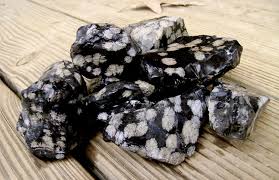
Gem of the Week: Snowflake Obsidian

Obsidian gemstones are natural glass and are the result of lava that cooled quickly. Obsidian helps to promote grounding and release tension and energy blockages. Color: Black to Smoky, Green, Mahogany, Rainbow, Snowflake


As stated above, Obsidian is made my lava flows that cooled very rapidly. This cooling process leaves the stone very brittle. When broken, it usually has very sharp edges. For this reason, it was often used in tools and weapons. Currently there are some tests being done with obsidian surgical scalpel blades.

Obsidian has been used since the stone age for tools, weapons, and pottery. In ancient Turkey and Greece, Obsidian was used for weaponry, mirrors, and decorations as well as in ritual circumcision.

In the Americas, Obsidian was highly valued and has been found traded over 200 miles away from their original mine. It gives us interesting markers for the economy of ancient cultures.

Today, Obsidian can be sharpened to a width of 3 nanometers thick at the edge of the blade and when looked at under a microscope, is still smooth and even, something that other knife edges cannot come close to. These blades are being tested to become medical scalpels as the cuts they make have fewer inflammatory cell reactions.

Saturday, February 8, 2014

Gem of the Week: Mother of Pearl

Mother of Pearl is an organic gemstone. Mother of Pearls decor is made from the glossy pearly inside of pearl oyster shell. Mother of pearl offers protection and aids in relaxing and soothing the mind and body. Color: Pearly


Mother of Pearl or Nacre, as it's also known, comes from the inside of mollusk shells. It also makes up the outer layer of pearls. Mother of Pearl was used extensively for buttons in the 1900's as well as other jewelry. The trade of Mother of Pearl is regulated by Convention on International Trade in Endangered Species of Wild Fauna and Flora.
Mother of Pearl has been used in architecture, fashion, and musical instruments. It's unique structure allows it to be used in mosaic. Mother of Pearl can also be tinted almost any artificial color.
Mother of Pearl has been used for centuries as a decorative accent on jewelry, boxes, furniture, weapons, and clothes.
Musical instruments from all families often have Mother of Pearl inlays in fret boards, valves, keys, and bows among other things to beautify the instrument.
Mother of Pearl is also used to make Caviar spoons because metal can easily ruin the taste of Caviar.